

Product guide · Food supplement
Hammer Labz Amino Strength 405g
Vegan BCAA powder from Hammer Labz, 405 g of powder. This guide sets out what the manufacturer states about the composition of Hammer Labz Amino Strength 405g, what independent research says about its main ingredients, and the safety and regulatory points that apply.
Back to the product- Named ingredients
- 9
- Amounts stated
- None
- Status
- Food supplement
- Evidence summaries
- 4
Overview
Manufacturer informationAmino Strength combines fermented, plant-based BCAAs (leucine, isoleucine and valine, as INSTAAMINOS) and vegan L-glutamine with betaine anhydrous, tart cherry extract and ActiGin®, plus coconut water with B and C vitamins.
Ingredients & composition
Manufacturer information| Ingredient | Amount |
|---|---|
| Leucine (fermented) | Not stated |
| Isoleucine (fermented) | Not stated |
| Valine (fermented) | Not stated |
| L-glutamine (vegan, fermented) | Not stated |
| Betaine anhydrous | Not stated |
| Tart cherry extract | Not stated |
| ActiGin® | Not stated |
| Coconut water | Not stated |
| Vitamins B and C | Not stated |
The manufacturer does not state the amount of any ingredient. Without amounts, the research summarised in this guide cannot be related to this product's dose.
Not covered in detail in this guide: Tart cherry extract, ActiGin®, Vitamins B and C.
Scientific background
Independent researchBCAAs (leucine, isoleucine, valine)
Branched-chain amino acids (leucine, isoleucine and valine) are essential amino acids found in protein-rich foods. Leucine stimulates muscle protein synthesis.
L-glutamine
Glutamine is the most abundant amino acid in the body and is made in muscle.
Betaine (trimethylglycine)
Betaine (trimethylglycine) occurs naturally in beetroot, spinach and wheat. It acts as an osmolyte and as a methyl donor in homocysteine metabolism.
Potassium and electrolytes
Potassium, sodium and other electrolytes regulate fluid balance, nerve signalling and muscle contraction.
Research evidence
Independent researchBCAAs (leucine, isoleucine, valine)
A systematic review found that pure BCAA supplementation may reduce muscle soreness after exercise, but evidence for improved strength, endurance or body composition is inconsistent1.
L-glutamine
A review concluded that the reasons usually given for taking glutamine (immune support, glycogen synthesis, reduced muscle breakdown) have received little support from well-controlled studies in healthy, well-nourished people2.
Betaine (trimethylglycine)
A meta-analysis found that betaine supplementation for at least 7 days improved muscular strength, especially lower-body strength, and may improve jumping performance3. The EU authorises a claim that betaine contributes to normal homocysteine metabolism at 1.5 g a day4.
Potassium and electrolytes
Authorised EU claims include that potassium contributes to normal muscle function and the maintenance of normal blood pressure4.
Evidence limitations
Independent researchThis product does not state all ingredient amounts, so the doses used in research cannot be compared with what one serving provides.
The studies summarised in this guide examined single ingredients. No published study has tested this product or this combination of ingredients.
BCAAs (leucine, isoleucine, valine)
Studies are small and diets are often poorly controlled1. Complete protein or essential amino acids are generally preferred for building muscle.
L-glutamine
Benefits shown in clinical nutrition (for example in critical illness) do not apply to healthy athletes2.
Betaine (trimethylglycine)
The studies are small and differ in dose and duration3.
Potassium and electrolytes
Electrolyte supplements are mainly relevant for prolonged exercise in the heat or large sweat losses.
Safety & potential risks
- Do not exceed the recommended daily dose.
- Food supplements should not be used as a substitute for a varied and balanced diet and a healthy lifestyle.
- Keep out of the reach of young children.
BCAAs (leucine, isoleucine, valine)
Generally well tolerated at studied doses.
L-glutamine
Glutamine was well tolerated at the doses studied2; a risk assessment identified an observed safe level of 14 g a day5.
Betaine (trimethylglycine)
Betaine is generally well tolerated; high intakes may raise blood cholesterol in some people.
Potassium and electrolytes
People with kidney disease, or taking blood-pressure medicines that raise potassium (such as ACE inhibitors or potassium-sparing diuretics), should not take potassium supplements without medical advice.
Regulatory status
Sold as a food supplement. No health claims are made for this product.
BCAAs (leucine, isoleucine, valine)
No health claim for this ingredient is authorised in the EU4; it is sold under national food-supplement rules6.
L-glutamine
No health claim for this ingredient is authorised in the EU4; botanical ingredients are sold under national food-supplement rules6.
Betaine (trimethylglycine)
Betaine is used in EU food supplements; the homocysteine claim may be used only in its authorised wording and conditions4.
Scientific references
- Julea M, Saleh SN. The effect of oral pure branched-chain amino acid supplementation on exercise performance and body composition: a systematic review. Cureus. 2025;17:e96017. PubMed 41346907
- Gleeson M. Dosing and efficacy of glutamine supplementation in human exercise and sport training. J Nutr. 2008;138:2045S-2049S. PubMed 18806122
- Zawieja E, Machek S, Zanchi NE, et al. Effects of chronic betaine supplementation on exercise performance: systematic review and meta-analysis. J Sports Sci. 2024;42:2131-2144. PubMed 39514262
- Commission Regulation (EU) No 432/2012 establishing a list of permitted health claims made on foods. Official Journal of the European Union. Source
- Shao A, Hathcock JN. Risk assessment for the amino acids taurine, L-glutamine and L-arginine. Regul Toxicol Pharmacol. 2008;50:376-399. PubMed 18325648
- Directive 2002/46/EC on the approximation of the laws of the Member States relating to food supplements. Official Journal of the European Union. Source
Sources checked against PubMed, Crossref or the official publisher on 2026-11-04. Manufacturer information is taken from the product's own data and has not been independently tested.
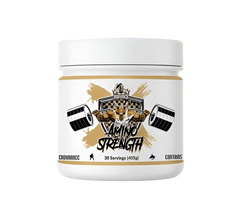
The product
Hammer Labz Amino Strength 405g
€29,00 · Sold out