

Product guide · Restricted substance
Swiss Pharmaceuticals Poison 300 g – High Stim Pre-Workout Formula
Stimulant formula from Swiss Pharmaceuticals, 300 g of powder. This guide sets out what the manufacturer states about the composition of Swiss Pharmaceuticals Poison 300 g, what independent research says about its main ingredients, and the safety and regulatory points that apply. It contains substances that are not authorised as food or medicine in the EU. This guide is educational: it does not recommend use and gives no directions for use.
Back to the product- Named ingredients
- 6
- Amounts stated
- None
- Status
- Restricted substance
- Evidence summaries
- 5
Overview
Manufacturer informationIngredients & composition
Manufacturer information| Ingredient | Amount |
|---|---|
| Citrulline malate | Not stated |
| Agmatine sulfate | Not stated |
| N-acetyl tyrosine | Not stated |
| Huperzine A | Not stated |
| Caffeine | Not stated |
| Other stimulant compounds (not named) | Not stated |
The manufacturer does not state the amount of any ingredient. Without amounts, the research summarised in this guide cannot be related to this product's dose.
Not covered in detail in this guide: Other stimulant compounds (not named).
Scientific background
Independent researchL-citrulline and citrulline malate
L-citrulline is an amino acid that the body converts to arginine, a precursor of nitric oxide, which widens blood vessels. Citrulline malate combines citrulline with malic acid1.
Agmatine sulfate
Agmatine is formed in the body from the amino acid arginine and acts as a signalling molecule in the nervous system. It is sold as agmatine sulfate in sports and nootropic products.
L-tyrosine
L-tyrosine is an amino acid that the body uses to make the neurotransmitters dopamine and noradrenaline. It is found in protein-rich foods; N-acetyl-L-tyrosine is a related form2.
Huperzine A
Huperzine A is an alkaloid from the club moss Huperzia serrata. It inhibits acetylcholinesterase, the enzyme that breaks down the neurotransmitter acetylcholine, and it has been used as a medicine for dementia in China3.
Caffeine
Caffeine is a stimulant that blocks adenosine receptors in the brain, reducing perceived effort and fatigue. It is found in coffee, tea and energy drinks and is a common ingredient in pre-workout products4.
Dicaffeine malate (sold as Infinergy®) is caffeine bonded to malic acid. Its caffeine adds to the total caffeine in a product, but labels do not always state the caffeine equivalent.
Research evidence
Independent researchL-citrulline and citrulline malate
A review of human studies found that citrulline supplementation raises plasma arginine, and that several studies report improved exercise performance or recovery, but the results are inconsistent1.
Agmatine sulfate
Controlled human research on agmatine for exercise performance is very limited. Published human data are mostly small studies and a long-term case report5.
L-tyrosine
A review found that tyrosine may support cognitive performance in short-term stressful or cognitively demanding situations, when these neurotransmitters are temporarily depleted, but found no consistent effect on physical exercise performance2.
Huperzine A
A Cochrane review found some benefit on cognitive function in people with Alzheimer's disease, but only one study was of adequate quality and size, so there was inadequate evidence to recommend its use3. A Cochrane review in mild cognitive impairment found the evidence insufficient6.
There is no good evidence that huperzine A improves focus or performance in healthy people.
Caffeine
The International Society of Sports Nutrition concludes that caffeine consistently improves exercise performance when consumed in doses of about 3–6 mg per kg of body mass, with benefits for muscular endurance, movement velocity, strength, sprinting, jumping and aerobic exercise4.
Evidence limitations
Independent researchThis product does not state all ingredient amounts, so the doses used in research cannot be compared with what one serving provides.
The studies summarised in this guide examined single ingredients. No published study has tested this product or this combination of ingredients.
L-citrulline and citrulline malate
Studies differ in dose, form (citrulline or citrulline malate, often with an unverified ratio) and exercise test, and many are small. The mechanism behind any performance effect is not established1.
Agmatine sulfate
There are no large randomised trials showing a performance benefit from agmatine in healthy people. Claims of better "pump" or focus are not established.
L-tyrosine
Most studies are small and use single doses in laboratory settings2.
Huperzine A
The trials are mostly small, of limited quality and in people with cognitive disease, so they do not apply to healthy users36.
Caffeine
Responses vary widely between people, partly because of genetics and habitual caffeine use. Many studies use pure caffeine, so results do not automatically apply to multi-ingredient products4.
Safety & potential risks
Independent researchL-citrulline and citrulline malate
Citrulline is generally well tolerated in the doses studied. Digestive discomfort has been reported, and people taking blood-pressure or erectile-dysfunction medication should ask a doctor, because citrulline raises arginine and nitric oxide production1.
Agmatine sulfate
A case report described 5 years of high daily agmatine intake without detected adverse effects5. One case report cannot establish safety for the wider population.
L-tyrosine
People taking MAO inhibitors or thyroid medication should not use tyrosine supplements without medical advice.
Huperzine A
As an acetylcholinesterase inhibitor, huperzine A can cause nausea, diarrhoea, sweating and a slow heart rate, and it may interact with medicines that affect acetylcholine or heart rate. Anyone taking medication or with heart, lung or digestive conditions should ask a doctor first.
Caffeine
EFSA concluded that single doses of up to 200 mg, and daily intakes of up to 400 mg from all sources, do not raise safety concerns for healthy adults. For pregnant and breastfeeding women, daily intakes up to 200 mg do not raise concerns for the foetus or infant7.
Higher intakes can cause anxiety, sleep disturbance, raised heart rate and blood pressure, and digestive upset. Combining several caffeine sources (coffee, energy drinks, pre-workouts) raises total intake74.
Regulatory status
This product contains an ingredient that is restricted or not authorised as a food supplement in some or all EU markets. No health benefits or directions for use are given.
L-citrulline and citrulline malate
L-citrulline is used in EU food supplements under national rules. No health claim for citrulline is authorised in the EU8.
Agmatine sulfate
Agmatine sulfate is used in some EU food supplements under national rules. No health claim is authorised8. Whether a product needs novel food authorisation depends on its history of use9.
L-tyrosine
Amino acids such as L-tyrosine are used in EU food supplements under national rules. No health claim is authorised8.
Huperzine A
Huperzine A is a pharmacologically active substance. Its status as a food ingredient is not harmonised in the EU, and some Member States treat it as a medicinal substance109.
Caffeine
Caffeine is permitted in EU foods and food supplements, subject to labelling rules. It is not on the World Anti-Doping Agency Prohibited List11.
Scientific references
- Gonzalez AM, Trexler ET. Effects of citrulline supplementation on exercise performance in humans: a review of the current literature. J Strength Cond Res. 2020;34:1480-1495. PubMed 31977835
- Jongkees BJ, Hommel B, Kühn S, et al. Effect of tyrosine supplementation on clinical and healthy populations under stress or cognitive demands: a review. J Psychiatr Res. 2015;70:50-57. PubMed 26424423
- Li J, Wu HM, Zhou RL, et al. Huperzine A for Alzheimer's disease. Cochrane Database Syst Rev. 2008;(2):CD005592. PubMed 18425924
- Guest NS, VanDusseldorp TA, Nelson MT, et al. International Society of Sports Nutrition position stand: caffeine and exercise performance. J Int Soc Sports Nutr. 2021;18:1. PubMed 33388079
- Gilad GM, Gilad VH. Long-term (5 years), high daily dosage of dietary agmatine: evidence of safety: a case report. J Med Food. 2014;17:1256-1259. PubMed 25247837
- Yue J, Dong BR, Lin X, et al. Huperzine A for mild cognitive impairment. Cochrane Database Syst Rev. 2012;12:CD008827. PubMed 23235666
- EFSA Panel on Dietetic Products, Nutrition and Allergies. Scientific Opinion on the safety of caffeine. EFSA Journal. 2015;13(5):4102. DOI 10.2903/j.efsa.2015.4102
- Commission Regulation (EU) No 432/2012 establishing a list of permitted health claims made on foods. Official Journal of the European Union. Source
- Regulation (EU) 2015/2283 on novel foods. Official Journal of the European Union. Source
- Directive 2001/83/EC on the Community code relating to medicinal products for human use. Official Journal of the European Union. Source
- World Anti-Doping Agency. The Prohibited List (current edition). Source
Sources checked against PubMed, Crossref or the official publisher on 2026-11-04. Manufacturer information is taken from the product's own data and has not been independently tested.
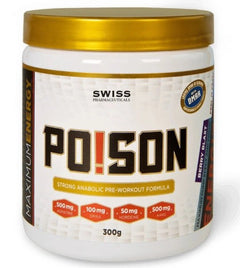
The product
Swiss Pharmaceuticals Poison 300 g – High Stim Pre-Workout Formula
€49,90