

Product guide · Food supplement
Holy Grail Holy Creatine 300g
Creatine monohydrate powder from Holy Grail, 300 g of powder. This guide sets out what the manufacturer states about the composition of Holy Grail Holy Creatine 300g, what independent research says about its main ingredient, and the safety and regulatory points that apply.
Back to the product- Named ingredients
- 1
- Amounts stated
- All
- Status
- Food supplement
- Evidence summaries
- 1
Overview
Manufacturer informationHoly Creatine is micronised creatine monohydrate from Creapure®, with no other ingredients listed. One scoop of about 5 g is mixed with 200–250 ml of water.
Ingredients & composition
Manufacturer information| Ingredient | Amount |
|---|---|
| Creatine monohydrate (Creapure®, micronised) | about 5 g per scoop |
Scientific background
Independent researchCreatine monohydrate
Creatine is a compound the body makes from the amino acids arginine, glycine and methionine, and it is also eaten in meat and fish. Most of it is stored in skeletal muscle, where phosphocreatine helps regenerate ATP, the immediate energy source for short, intense muscle contractions1.
Creatine monohydrate is the form used in most of the published research12.
Research evidence
Independent researchCreatine monohydrate
Supplementation raises muscle creatine stores. The International Society of Sports Nutrition position stand concludes that creatine monohydrate is an effective ergogenic supplement for increasing high-intensity exercise capacity and lean body mass during training1.
A meta-analysis of randomised trials found improved upper-limb strength when creatine was combined with resistance training3, and a meta-analysis in older adults found greater gains in muscle mass and strength with creatine plus resistance training than with training alone4.
In the EU, the European Food Safety Authority (EFSA) assessed the evidence and found a cause-and-effect relationship between a daily intake of 3 g of creatine and increased physical performance in successive bursts of short-term, high-intensity exercise5. That claim is authorised under Regulation (EU) No 432/20126, and a second claim on muscle strength in adults over 55 who do resistance training under Regulation (EU) 2017/6727.
Evidence limitations
Independent researchNo published study has tested this specific product; the research summarised here concerns the ingredient itself.
Safety & potential risks
- Do not exceed the recommended daily dose.
- Food supplements should not be used as a substitute for a varied and balanced diet and a healthy lifestyle.
- Keep out of the reach of young children.
Creatine monohydrate
Reviews of the clinical literature report no consistent adverse effects of creatine monohydrate in healthy people at commonly studied intakes. A meta-analysis found no significant effect on markers of kidney function82.
People with kidney disease, and anyone taking medication, should speak to a doctor before using creatine. A small rise in blood creatinine is expected with supplementation and can be misread as reduced kidney function2.
Regulatory status
Sold as a food supplement. No health claims are made for this product.
Scientific references
- Kreider RB, Kalman DS, Antonio J, et al. International Society of Sports Nutrition position stand: safety and efficacy of creatine supplementation in exercise, sport, and medicine. J Int Soc Sports Nutr. 2017;14:18. PubMed 28615996
- Antonio J, Candow DG, Forbes SC, et al. Common questions and misconceptions about creatine supplementation: what does the scientific evidence really show? J Int Soc Sports Nutr. 2021;18:13. PubMed 33557850
- Lanhers C, Pereira B, Naughton G, et al. Creatine supplementation and upper limb strength performance: a systematic review and meta-analysis. Sports Med. 2017;47:163-173. PubMed 27328852
- Devries MC, Phillips SM. Creatine supplementation during resistance training in older adults: a meta-analysis. Med Sci Sports Exerc. 2014;46:1194-1203. PubMed 24576864
- EFSA Panel on Dietetic Products, Nutrition and Allergies. Scientific Opinion on the substantiation of health claims related to creatine and increase in physical performance during short-term, high intensity, repeated exercise bouts. EFSA Journal. 2011;9(7):2303. DOI 10.2903/j.efsa.2011.2303
- Commission Regulation (EU) No 432/2012 establishing a list of permitted health claims made on foods. Official Journal of the European Union. Source
- Commission Implementing Regulation (EU) 2017/672 authorising a health claim made on foods (creatine and muscle strength in adults over 55). Official Journal of the European Union. Source
- de Souza E Silva A, Pertille A, Reis Barbosa CG, et al. Effects of creatine supplementation on renal function: a systematic review and meta-analysis. J Ren Nutr. 2019;29:480-489. PubMed 31375416
- Directive 2002/46/EC on the approximation of the laws of the Member States relating to food supplements. Official Journal of the European Union. Source
Sources checked against PubMed, Crossref or the official publisher on 2026-11-04. Manufacturer information is taken from the product's own data and has not been independently tested.
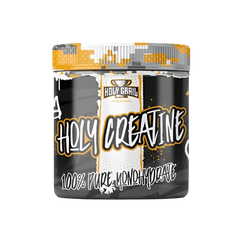
The product
Holy Grail Holy Creatine 300g
€20,00 · Sold out