

Product guide · Under compliance review
Killer Labz Brute Bcaa 60 Serving
Amino acid supplement from Killer Labz, powder. This guide sets out what the manufacturer states about the composition of Killer Labz Brute Bcaa 60 Serving, what independent research says about its main ingredients, and the safety and regulatory points that apply. Its regulatory status is under compliance review. This guide is educational and does not recommend use.
Back to the product- Named ingredients
- 8
- Amounts stated
- None
- Status
- Under compliance review
- Evidence summaries
- 5
Overview
Manufacturer informationIngredients & composition
Manufacturer information| Ingredient | Amount |
|---|---|
| Micronized L-leucine | Not stated |
| Micronized L-isoleucine | Not stated |
| Micronized L-valine | Not stated |
| L-taurine | Not stated |
| L-glutamine | Not stated |
| Epicatechin | Not stated |
| 5α-hydroxy-laxogenin | Not stated |
| Black pepper extract (piperine) | Not stated |
The manufacturer does not state the amount of any ingredient. Without amounts, the research summarised in this guide cannot be related to this product's dose.
Not covered in detail in this guide: Epicatechin.
Scientific background
Independent researchBCAAs (leucine, isoleucine, valine)
Branched-chain amino acids (leucine, isoleucine and valine) are essential amino acids found in protein-rich foods. Leucine stimulates muscle protein synthesis.
Taurine
Taurine is an amino sulfonic acid made by the body and found in meat and fish. It is involved in bile acid formation and cell volume regulation, and it is a common energy-drink ingredient1.
L-glutamine
Glutamine is the most abundant amino acid in the body and is made in muscle.
Plant "anabolic" sterols (laxogenin, ecdysterone)
Laxogenin (5α-hydroxy-laxogenin) and ecdysteroids such as ecdysterone (20-hydroxyecdysone, from Ajuga turkestanica or Cyanotis) are plant sterols marketed as natural anabolic agents.
Piperine (black pepper extract, BioPerine®)
Piperine is the pungent alkaloid of black pepper, added to supplements as a "bioavailability enhancer".
Research evidence
Independent researchBCAAs (leucine, isoleucine, valine)
A systematic review found that pure BCAA supplementation may reduce muscle soreness after exercise, but evidence for improved strength, endurance or body composition is inconsistent2.
Taurine
There is no authorised EU health claim for taurine, and evidence that taurine on its own improves exercise performance in healthy people is limited.
L-glutamine
A review concluded that the reasons usually given for taking glutamine (immune support, glycogen synthesis, reduced muscle breakdown) have received little support from well-controlled studies in healthy, well-nourished people3.
Plant "anabolic" sterols (laxogenin, ecdysterone)
In a 12-week randomised double-blind training study, a commercial ecdysterone product gave no additional benefit over training alone, and its actual content differed markedly from the label4. In castrated rats, 5α-hydroxy-laxogenin showed neither androgenic nor anabolic effects5.
Piperine (black pepper extract, BioPerine®)
A 2026 review of 22 human pharmacokinetic studies found that reports of enhanced nutrient absorption come mainly from manufacturer-affiliated studies, and that independent trials did not confirm enhancement for curcumin or resveratrol at supplement doses6.
Evidence limitations
Independent researchThis product does not state all ingredient amounts, so the doses used in research cannot be compared with what one serving provides.
The studies summarised in this guide examined single ingredients. No published study has tested this product or this combination of ingredients.
BCAAs (leucine, isoleucine, valine)
Studies are small and diets are often poorly controlled2. Complete protein or essential amino acids are generally preferred for building muscle.
Taurine
Most of the research uses taurine in combination with caffeine or other ingredients.
L-glutamine
Benefits shown in clinical nutrition (for example in critical illness) do not apply to healthy athletes3.
Plant "anabolic" sterols (laxogenin, ecdysterone)
Label accuracy is poor and human trials are few4.
Piperine (black pepper extract, BioPerine®)
Piperine raises blood levels of other compounds mainly by inhibiting drug-metabolising enzymes (CYP3A4, CYP2C9) and P-glycoprotein, not by improving absorption6.
Safety & potential risks
- Do not exceed the recommended daily dose.
- Food supplements should not be used as a substitute for a varied and balanced diet and a healthy lifestyle.
- Keep out of the reach of young children.
BCAAs (leucine, isoleucine, valine)
Generally well tolerated at studied doses.
Taurine
A risk assessment identified an observed safe level of 3 g a day of supplemental taurine7, and EFSA did not raise safety concerns for the amounts used in energy drinks1.
L-glutamine
Glutamine was well tolerated at the doses studied3; a risk assessment identified an observed safe level of 14 g a day7.
Plant "anabolic" sterols (laxogenin, ecdysterone)
Human safety data are limited.
Piperine (black pepper extract, BioPerine®)
Because it inhibits drug-metabolising enzymes, piperine can raise blood levels of prescription medicines, including drugs with a narrow therapeutic index. People taking medication should ask a pharmacist first6.
Regulatory status
Sold as a food supplement. No health claims are made for this product.
BCAAs (leucine, isoleucine, valine)
No health claim for this ingredient is authorised in the EU8; it is sold under national food-supplement rules9.
Taurine
Taurine is used in EU foods and food supplements. No health claim is authorised8.
L-glutamine
No health claim for this ingredient is authorised in the EU8; botanical ingredients are sold under national food-supplement rules9.
Scientific references
- EFSA. The use of taurine and D-glucurono-gamma-lactone as constituents of the so-called energy drinks. EFSA Journal. 2009;7(2):935. DOI 10.2903/j.efsa.2009.935
- Julea M, Saleh SN. The effect of oral pure branched-chain amino acid supplementation on exercise performance and body composition: a systematic review. Cureus. 2025;17:e96017. PubMed 41346907
- Gleeson M. Dosing and efficacy of glutamine supplementation in human exercise and sport training. J Nutr. 2008;138:2045S-2049S. PubMed 18806122
- Dissemond J, Havers T, Held S, et al. How reliable is the labeling of a commercial phytosteroid product? A 12-week randomized double-blind training study. J Int Soc Sports Nutr. 2025;22:2540408. PubMed 40781783
- Derwand D, Zierau O, Wolf CA, et al. Effects of the dietary supplement 5α-hydroxy-laxogenin in the orchiectomized rat model. Drug Test Anal. 2025;17:1743-1749. PubMed 40038867
- Kaneko M. Enhancement without a rationale? Black pepper extract (piperine) in dietary supplements and the future of formulation: a perspective from Japan. Front Nutr. 2026;13:1981406. PubMed 42964084
- Shao A, Hathcock JN. Risk assessment for the amino acids taurine, L-glutamine and L-arginine. Regul Toxicol Pharmacol. 2008;50:376-399. PubMed 18325648
- Commission Regulation (EU) No 432/2012 establishing a list of permitted health claims made on foods. Official Journal of the European Union. Source
- Directive 2002/46/EC on the approximation of the laws of the Member States relating to food supplements. Official Journal of the European Union. Source
- Regulation (EU) 2015/2283 on novel foods. Official Journal of the European Union. Source
- World Anti-Doping Agency. The Prohibited List (current edition). Source
Sources checked against PubMed, Crossref or the official publisher on 2026-11-04. Manufacturer information is taken from the product's own data and has not been independently tested.
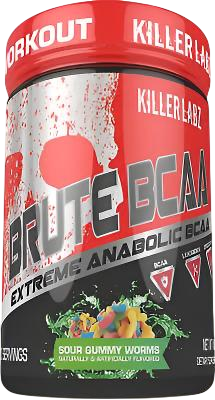
The product
Killer Labz Brute Bcaa 60 Serving
€45,00 · Sold out