

Product guide · Under compliance review
Revange Nutrition Noopept RX Pro
Specialised product from Revange Nutrition. This guide sets out what the manufacturer states about the composition of Revange Nutrition Noopept RX Pro, what independent research says about its main ingredients, and the safety and regulatory points that apply. Its regulatory status is under compliance review. This guide is educational and does not recommend use.
Back to the product- Named ingredients
- 10
- Amounts stated
- None
- Status
- Under compliance review
- Evidence summaries
- 10
Overview
Manufacturer informationIngredients & composition
Manufacturer information| Ingredient | Amount |
|---|---|
| Noopept | Not stated |
| Alpha GPC | Not stated |
| Bacopa monnieri | Not stated |
| Rhodiola rosea | Not stated |
| Ashwagandha | Not stated |
| 5-HTP | Not stated |
| L-theanine | Not stated |
| Phosphatidylserine | Not stated |
| Huperzine A | Not stated |
| N-acetyl tyrosine | Not stated |
The manufacturer does not state the amount of any ingredient. Without amounts, the research summarised in this guide cannot be related to this product's dose.
Scientific background
Independent researchNoopept (omberacetam)
Noopept (N-phenylacetyl-L-prolylglycine ethyl ester, omberacetam) is a synthetic compound described as an active pharmaceutical ingredient with nootropic activity1.
Choline (choline bitartrate, alpha-GPC)
Choline is an essential nutrient used to make cell membranes and the neurotransmitter acetylcholine. EFSA set an adequate intake of 400 mg a day for adults2. Supplements supply it as choline bitartrate, alpha-GPC or citicoline.
Bacopa monnieri (brahmi)
Bacopa monnieri (brahmi) is an Ayurvedic herb whose extracts contain bacosides.
Rhodiola rosea
Rhodiola rosea is a plant from cold regions whose root extract (standardised to rosavins and salidroside) is marketed as an adaptogen.
Ashwagandha (Withania somnifera)
Ashwagandha (Withania somnifera) is an Ayurvedic herb marketed as an adaptogen; extracts are standardised to withanolides.
5-HTP (5-hydroxytryptophan)
5-HTP is the direct precursor of the neurotransmitter serotonin and is usually extracted from Griffonia simplicifolia seeds3.
L-theanine
L-theanine is an amino acid found in tea leaves, often combined with caffeine.
Phosphatidylserine, lecithin and phospholipids
Phosphatidylserine and other phospholipids are components of cell membranes. Lecithin is a mixture of phospholipids, often from sunflower or soy.
Huperzine A
Huperzine A is an alkaloid from the club moss Huperzia serrata. It inhibits acetylcholinesterase, the enzyme that breaks down the neurotransmitter acetylcholine, and it has been used as a medicine for dementia in China4.
L-tyrosine
L-tyrosine is an amino acid that the body uses to make the neurotransmitters dopamine and noradrenaline. It is found in protein-rich foods; N-acetyl-L-tyrosine is a related form5.
Research evidence
Independent researchNoopept (omberacetam)
There are no robust controlled trials in healthy people showing improved memory or focus. Published research is mainly chemical, animal or from limited clinical settings1.
Choline (choline bitartrate, alpha-GPC)
The EU authorises claims that choline contributes to normal lipid metabolism, homocysteine metabolism and liver function for foods that are a source of choline6. Claims that choline improves focus or exercise performance are not authorised.
Bacopa monnieri (brahmi)
A 2026 network meta-analysis found that bacopa, particularly at high doses, shows promise as a cognitive enhancer compared with ginkgo in healthy adults, although the lack of direct comparisons limits the strength of the evidence7.
Rhodiola rosea
A 2025 meta-analysis concluded that Rhodiola supplementation can improve endurance performance and related biomarkers, although differences between studies call for cautious interpretation8.
Ashwagandha (Withania somnifera)
A 2026 meta-analysis found that current evidence does not establish that ashwagandha meaningfully enhances resistance-training adaptations; possible benefits for maximal strength rest on a small, low-certainty evidence base9.
5-HTP (5-hydroxytryptophan)
A review of controlled trials examined 5-HTP for depression; the evidence is limited and of mixed quality3. There is no authorised EU claim for 5-HTP.
L-theanine
A meta-analysis of randomised trials in healthy people found that theanine with caffeine, and theanine alone, could benefit cognitive and mood outcomes10.
Phosphatidylserine, lecithin and phospholipids
A 2026 systematic review concluded that current evidence does not support citicoline or phosphatidylserine compounds as effective cognitive enhancers in mental disorders11.
Huperzine A
A Cochrane review found some benefit on cognitive function in people with Alzheimer's disease, but only one study was of adequate quality and size, so there was inadequate evidence to recommend its use4. A Cochrane review in mild cognitive impairment found the evidence insufficient12.
There is no good evidence that huperzine A improves focus or performance in healthy people.
L-tyrosine
A review found that tyrosine may support cognitive performance in short-term stressful or cognitively demanding situations, when these neurotransmitters are temporarily depleted, but found no consistent effect on physical exercise performance5.
Evidence limitations
Independent researchThis product does not state all ingredient amounts, so the doses used in research cannot be compared with what one serving provides.
The studies summarised in this guide examined single ingredients. No published study has tested this product or this combination of ingredients.
Noopept (omberacetam)
Evidence in humans is very limited.
Choline (choline bitartrate, alpha-GPC)
Evidence on cognitive or performance effects in healthy adults is limited.
Bacopa monnieri (brahmi)
Effects build up over weeks, and studies are small7.
Rhodiola rosea
Studies are heterogeneous in extract and dose8.
Ashwagandha (Withania somnifera)
Trials are small, short and often funded by extract manufacturers9.
5-HTP (5-hydroxytryptophan)
Most trials are small and old3.
L-theanine
More research with realistic doses and in everyday settings is needed10.
Phosphatidylserine, lecithin and phospholipids
Studies have methodological limitations and a high risk of bias11.
Huperzine A
The trials are mostly small, of limited quality and in people with cognitive disease, so they do not apply to healthy users412.
L-tyrosine
Most studies are small and use single doses in laboratory settings5.
Safety & potential risks
Independent researchNoopept (omberacetam)
Human safety data are limited. Official medicines control laboratories in Europe and Australia have found illicit "smart drugs" sold as nootropic products and warn of their dangers13.
Choline (choline bitartrate, alpha-GPC)
High intakes can cause a fishy body odour, sweating and digestive upset.
Bacopa monnieri (brahmi)
It can cause digestive upset and may interact with thyroid and sedative medicines.
Rhodiola rosea
Generally well tolerated; it may interact with antidepressants and blood-pressure or diabetes medicines.
Ashwagandha (Withania somnifera)
Case series describe ashwagandha-associated liver injury, which can be severe in people with existing liver disease14. It may also affect thyroid hormones and is not recommended in pregnancy.
5-HTP (5-hydroxytryptophan)
Safety concerns include serotonin syndrome when combined with antidepressants or other serotonergic substances, and historical reports of eosinophilia-myalgia syndrome linked to contaminated products3. Do not combine with antidepressants, migraine triptans or tramadol.
L-theanine
Generally well tolerated at studied doses.
Phosphatidylserine, lecithin and phospholipids
Generally well tolerated; soy lecithin may not be suitable for people with soy allergy.
Huperzine A
As an acetylcholinesterase inhibitor, huperzine A can cause nausea, diarrhoea, sweating and a slow heart rate, and it may interact with medicines that affect acetylcholine or heart rate. Anyone taking medication or with heart, lung or digestive conditions should ask a doctor first.
L-tyrosine
People taking MAO inhibitors or thyroid medication should not use tyrosine supplements without medical advice.
Regulatory status
Flagged for compliance review: this product is listed as a food supplement in our catalogue, but its EU status (food supplement, novel food or medicinal product) has not been verified. No benefits or health claims are made.
Noopept (omberacetam)
Noopept is not authorised as a food or food supplement ingredient in the EU15. Substances with a pharmacological action on the nervous system are regulated as medicinal products in the EU, and Noopept is not an authorised medicine16.
Choline (choline bitartrate, alpha-GPC)
Choline is a permitted nutrient source in EU food supplements176.
Bacopa monnieri (brahmi)
No health claim for this ingredient is authorised in the EU6; it is sold under national food-supplement rules17.
Rhodiola rosea
No health claim is authorised6.
Ashwagandha (Withania somnifera)
No health claim for this ingredient is authorised in the EU6; botanical ingredients are sold under national food-supplement rules17.
5-HTP (5-hydroxytryptophan)
5-HTP is pharmacologically active; some EU Member States restrict it in food supplements or classify it as medicinal16. No health claim for this ingredient is authorised in the EU6; botanical ingredients are sold under national food-supplement rules17.
L-theanine
No health claim for this ingredient is authorised in the EU6; botanical ingredients are sold under national food-supplement rules17.
Phosphatidylserine, lecithin and phospholipids
No health claim for this ingredient is authorised in the EU6; it is sold under national food-supplement rules17.
Huperzine A
Huperzine A is a pharmacologically active substance. Its status as a food ingredient is not harmonised in the EU, and some Member States treat it as a medicinal substance1615.
L-tyrosine
Amino acids such as L-tyrosine are used in EU food supplements under national rules. No health claim is authorised6.
Scientific references
- Araj SK, Szeleszczuk Ł, Gubica T, et al. Physicochemical and structural analysis of N-phenylacetyl-L-prolylglycine ethyl ester (Noopept): an active pharmaceutical ingredient with nootropic activity. J Pharm Biomed Anal. 2025;252:116474. PubMed 39298839
- EFSA Panel on Dietetic Products, Nutrition and Allergies. Dietary Reference Values for choline. EFSA Journal. 2016;14(8):4484. DOI 10.2903/j.efsa.2016.4484
- Turner EH, Loftis JM, Blackwell AD. Serotonin a la carte: supplementation with the serotonin precursor 5-hydroxytryptophan. Pharmacol Ther. 2006;109:325-338. PubMed 16023217
- Li J, Wu HM, Zhou RL, et al. Huperzine A for Alzheimer's disease. Cochrane Database Syst Rev. 2008;(2):CD005592. PubMed 18425924
- Jongkees BJ, Hommel B, Kühn S, et al. Effect of tyrosine supplementation on clinical and healthy populations under stress or cognitive demands: a review. J Psychiatr Res. 2015;70:50-57. PubMed 26424423
- Commission Regulation (EU) No 432/2012 establishing a list of permitted health claims made on foods. Official Journal of the European Union. Source
- Tiemtad P, Ingkaninan K, Temkitthawon P, et al. Comparative effects of Bacopa monnieri and Ginkgo biloba on cognitive functions: a systematic review and network meta-analysis. Phytomedicine. 2026;153:157915. PubMed 41678913
- Wang X, Yang X, Gao Z, et al. The effect of Rhodiola rosea supplementation on endurance performance and related biomarkers: a systematic review and meta-analysis. Front Nutr. 2025;12:1645346. PubMed 41080184
- Lee JC, Heo AS. Adjunctive ashwagandha (Withania somnifera) supplementation and resistance-training adaptations in healthy adults: a systematic review and random-effects meta-analysis. Nutrients. 2026;18. PubMed 42738987
- Payne ER, Aceves-Martins M, Dubost J, et al. Effects of tea (Camellia sinensis) or its bioactive compounds L-theanine or L-theanine plus caffeine on cognition, sleep, and mood in healthy participants: a systematic review and meta-analysis of randomized controlled trials. Nutr Rev. 2025;83:1873-1891. PubMed 40314930
- Kucuksahin NG, Kaya TT, Halac E, et al. The impact of citicoline/phosphatidylserine supplementation on cognitive performance and executive functions in mental disorders: a systematic review of controlled trials. Hum Psychopharmacol. 2026;41:e70058. PubMed 42538853
- Yue J, Dong BR, Lin X, et al. Huperzine A for mild cognitive impairment. Cochrane Database Syst Rev. 2012;12:CD008827. PubMed 23235666
- Vanhee C, Deconinck E, George M, et al. The occurrence of illicit smart drugs or nootropics in Europe and Australia and their associated dangers: results from a market surveillance study by 12 official medicines control laboratories. J Xenobiot. 2025;15:88. PubMed 40558871
- Philips CA, Valsan A, Theruvath AH, et al. Ashwagandha-induced liver injury: a case series from India and literature review. Hepatol Commun. 2023;7. PubMed 37756041
- Regulation (EU) 2015/2283 on novel foods. Official Journal of the European Union. Source
- Directive 2001/83/EC on the Community code relating to medicinal products for human use. Official Journal of the European Union. Source
- Directive 2002/46/EC on the approximation of the laws of the Member States relating to food supplements. Official Journal of the European Union. Source
Sources checked against PubMed, Crossref or the official publisher on 2026-11-04. Manufacturer information is taken from the product's own data and has not been independently tested.
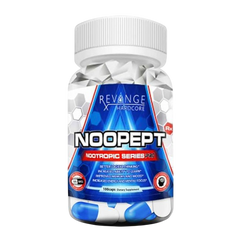
The product
Revange Nutrition Noopept RX Pro
€54,90 · Sold out