

Product guide · Under compliance review
Revange Nutrition Test Restore – Botanical Formula for Men
Botanical formula for men from Revange Nutrition. This guide sets out what the manufacturer states about the composition of Revange Nutrition Test Restore, what independent research says about its main ingredients, and the safety and regulatory points that apply. Its regulatory status is under compliance review. This guide is educational and does not recommend use.
Back to the product- Named ingredients
- 10
- Amounts stated
- All
- Status
- Under compliance review
- Evidence summaries
- 11
Overview
Manufacturer informationIngredients & composition
Manufacturer information| Ingredient | Amount |
|---|---|
| Stinging nettle extract | 200 mg |
| Horny goat weed | 150 mg |
| Tongkat ali | 150 mg |
| Armistane | 50 mg |
| Fenugreek extract | 50 mg |
| DIM | 50 mg |
| Saw palmetto | 50 mg |
| Coleus forskohlii | 20 mg |
| Vitamin D3 (10,000 IU) & zinc | 10 mg |
| Piperine | 10 mg |
Scientific background
Independent researchStinging nettle root (Urtica dioica)
Stinging nettle root extract is used, alone or with saw palmetto, for urinary symptoms of benign prostatic enlargement.
Horny goat weed (Epimedium, icariin)
Horny goat weed (Epimedium species) contains icariin, which inhibits the enzyme PDE5 in laboratory studies, the same target as erectile-dysfunction medicines.
Tongkat ali (Eurycoma longifolia)
Tongkat ali (Eurycoma longifolia) is a Southeast Asian shrub whose root extract is marketed for male vitality2.
Arimistane (androsta-3,5-diene-7,17-dione)
Arimistane (androsta-3,5-diene-7,17-dione) is sold as an aromatase inhibitor, a substance that blocks the conversion of testosterone to oestrogen. It is also related to the breakdown of 7-oxo-DHEA3.
Fenugreek (Trigonella foenum-graecum)
Fenugreek seed extracts, rich in saponins, are marketed for male vitality and testosterone.
DIM (3,3'-diindolylmethane)
DIM (3,3'-diindolylmethane) forms from indole-3-carbinol in cruciferous vegetables such as broccoli and is marketed for oestrogen balance.
Saw palmetto (Serenoa repens)
Saw palmetto (Serenoa repens) berry extract is used for urinary symptoms of benign prostatic enlargement; some extracts are licensed herbal medicines in Europe4.
Coleus forskohlii (forskolin)
Coleus forskohlii root extract is standardised to forskolin, which raises the cell signalling molecule cAMP.
Vitamin D3 (cholecalciferol)
Vitamin D is made in the skin in sunlight and is found in a few foods. It is needed for calcium absorption and bone health. EFSA set an adequate intake of 15 µg (600 IU) a day for adults5. 1 µg equals 40 IU.
Zinc
Zinc is an essential trace element for enzymes, immune function and protein synthesis. EFSA set population reference intakes of 9.4–16.3 mg a day for men and 7.5–12.7 mg a day for women, depending on dietary phytate6.
Piperine (black pepper extract, BioPerine®)
Piperine is the pungent alkaloid of black pepper, added to supplements as a "bioavailability enhancer".
Research evidence
Independent researchStinging nettle root (Urtica dioica)
A randomised controlled trial in men with benign prostatic hyperplasia assessed nettle root extract on clinical and biochemical parameters7.
Horny goat weed (Epimedium, icariin)
Evidence for benefits comes mainly from laboratory and animal studies; robust human trials are lacking.
Tongkat ali (Eurycoma longifolia)
A meta-analysis of clinical trials found that tongkat ali supplementation increased total testosterone in men, particularly in men with low testosterone, but concluded that more research is needed before clinical use2.
Arimistane (androsta-3,5-diene-7,17-dione)
Published research concerns anti-doping detection of arimistane and its metabolites3. There are no controlled human trials of its effects or safety.
Fenugreek (Trigonella foenum-graecum)
A 2026 meta-analysis of randomised trials found a possible small effect on total testosterone, with very uncertain evidence and no stable benefit for free testosterone; it concluded that current evidence does not support testosterone-boosting claims8.
DIM (3,3'-diindolylmethane)
A study in premenopausal women examined whether DIM supplements favoured a benign oestrogen metabolism pathway and reduced body fat9. Evidence in men is lacking.
Saw palmetto (Serenoa repens)
A systematic review of recent clinical studies found improvements in prostate symptom scores in several trials, more consistently with hexane-extracted preparations, with variable effects on urinary flow4.
Coleus forskohlii (forskolin)
A 2026 systematic review suggested that Coleus forskohlii extract may serve as a complementary therapy for obesity but found the evidence insufficient without high-quality, long-term trials10.
Vitamin D3 (cholecalciferol)
Authorised EU claims include that vitamin D contributes to the maintenance of normal bones, muscle function and immune function11.
In the large VITAL trial, 2000 IU (50 µg) a day of vitamin D3 did not lower the incidence of invasive cancer or major cardiovascular events compared with placebo12. A meta-analysis found that vitamin D supplements did not prevent fractures or falls, or have clinically meaningful effects on bone density13.
Zinc
Authorised EU claims include that zinc contributes to normal immune function, normal fertility and reproduction, and the maintenance of normal testosterone levels in the blood11. These claims do not mean that extra zinc raises testosterone in people with adequate zinc.
Piperine (black pepper extract, BioPerine®)
A 2026 review of 22 human pharmacokinetic studies found that reports of enhanced nutrient absorption come mainly from manufacturer-affiliated studies, and that independent trials did not confirm enhancement for curcumin or resveratrol at supplement doses14.
Evidence limitations
Independent researchThe studies summarised in this guide examined single ingredients. No published study has tested this product or this combination of ingredients.
Stinging nettle root (Urtica dioica)
Trials are few and small.
Horny goat weed (Epimedium, icariin)
Human evidence is limited.
Tongkat ali (Eurycoma longifolia)
The trials are small, often industry-funded and use different extracts2.
Arimistane (androsta-3,5-diene-7,17-dione)
Effects in humans are not established.
Fenugreek (Trigonella foenum-graecum)
The evidence is very uncertain8.
DIM (3,3'-diindolylmethane)
Human trials are few and small.
Saw palmetto (Serenoa repens)
Extracts, doses and study designs vary widely, limiting comparison4. Results from licensed extracts do not apply to all supplements.
Coleus forskohlii (forskolin)
High-quality long-term trials are lacking10.
Vitamin D3 (cholecalciferol)
Benefits are clearest for correcting deficiency. Trials in people with adequate vitamin D status show little benefit for bone, cancer or heart outcomes1213.
Zinc
Effects beyond correcting low zinc status are not established.
Piperine (black pepper extract, BioPerine®)
Piperine raises blood levels of other compounds mainly by inhibiting drug-metabolising enzymes (CYP3A4, CYP2C9) and P-glycoprotein, not by improving absorption14.
Safety & potential risks
For this product
The manufacturer states 10 mg of vitamin D (as stated). That is above the upper level of 100 µg (4000 IU) a day for adults1. Intakes above the upper level are not recommended without medical advice.
- Do not exceed the recommended daily dose.
- Food supplements should not be used as a substitute for a varied and balanced diet and a healthy lifestyle.
- Keep out of the reach of young children.
Stinging nettle root (Urtica dioica)
Generally well tolerated; urinary symptoms should be assessed by a doctor.
Horny goat weed (Epimedium, icariin)
Case reports describe toxicity with severe muscle spasms and raised creatine kinase15, and new-onset psychosis in a person with Parkinson's disease16.
Tongkat ali (Eurycoma longifolia)
Generally well tolerated in short trials; long-term safety is not established. People with hormone-sensitive conditions should ask a doctor first.
Arimistane (androsta-3,5-diene-7,17-dione)
Blocking oestrogen production can affect bone, lipids and mood. Human safety data are lacking.
Fenugreek (Trigonella foenum-graecum)
Generally well tolerated; it may lower blood sugar and can cause digestive upset. Avoid in pregnancy.
DIM (3,3'-diindolylmethane)
DIM can affect hormone metabolism; people with hormone-sensitive conditions or taking hormonal medicines should ask a doctor first.
Saw palmetto (Serenoa repens)
Generally well tolerated. Urinary symptoms should be assessed by a doctor before self-treatment to rule out other causes.
Coleus forskohlii (forskolin)
It may lower blood pressure and interact with blood-pressure and blood-thinning medicines.
Vitamin D3 (cholecalciferol)
EFSA set a tolerable upper intake level of 100 µg (4000 IU) a day for adults, based on persistent hypercalciuria (excess calcium in the urine) as an early sign of excess vitamin D1. Long-term intakes above this level can raise blood calcium and harm the kidneys. High-dose products should only be used on medical advice.
Zinc
The EU Scientific Committee on Food set a tolerable upper intake level of 25 mg a day for adults; long-term excess can cause copper deficiency17.
Piperine (black pepper extract, BioPerine®)
Because it inhibits drug-metabolising enzymes, piperine can raise blood levels of prescription medicines, including drugs with a narrow therapeutic index. People taking medication should ask a pharmacist first14.
Regulatory status
Sold as a food supplement. No health claims are made for this product.
Stinging nettle root (Urtica dioica)
No health claim for this ingredient is authorised in the EU11; it is sold under national food-supplement rules18.
Horny goat weed (Epimedium, icariin)
No health claim for this ingredient is authorised in the EU11; it is sold under national food-supplement rules18.
Tongkat ali (Eurycoma longifolia)
No health claim for this ingredient is authorised in the EU11; botanical ingredients are sold under national food-supplement rules18.
Arimistane (androsta-3,5-diene-7,17-dione)
Aromatase inhibitors are prohibited at all times by the World Anti-Doping Agency319, and arimistane is not authorised as a food ingredient in the EU20.
Fenugreek (Trigonella foenum-graecum)
No health claim for this ingredient is authorised in the EU11; botanical ingredients are sold under national food-supplement rules18.
DIM (3,3'-diindolylmethane)
No health claim for this ingredient is authorised in the EU11; it is sold under national food-supplement rules18.
Saw palmetto (Serenoa repens)
Some saw palmetto extracts are authorised as traditional or well-established herbal medicines; as a food supplement ingredient no health claim is authorised2111.
Coleus forskohlii (forskolin)
No health claim for this ingredient is authorised in the EU11; it is sold under national food-supplement rules18.
Vitamin D3 (cholecalciferol)
It is a permitted nutrient in EU food supplements18; authorised claims may only be used in their approved wording and when the product is at least a source of the nutrient11.
Scientific references
- EFSA NDA Panel. Scientific opinion on the tolerable upper intake level for vitamin D, including the derivation of a conversion factor for calcidiol monohydrate. EFSA Journal. 2023;21:8145. DOI 10.2903/j.efsa.2023.8145
- Leisegang K, Finelli R, Sikka SC, et al. Eurycoma longifolia (Jack) improves serum total testosterone in men: a systematic review and meta-analysis of clinical trials. Medicina (Kaunas). 2022;58:1047. PubMed 36013514
- Martínez Brito D, Leogrande P, Colamonici C, et al. Arimistane: degradation product or metabolite of 7-oxo-DHEA? Drug Test Anal. 2021;13:1430-1439. PubMed 33783974
- Schwartzmann I, Redondo A, Farré A, et al. Efficacy and safety of Serenoa repens in benign prostatic disorders: a systematic review of recent clinical evidence. Drugs Context. 2026;15. PubMed 42157952
- EFSA NDA Panel. Dietary reference values for vitamin D. EFSA Journal. 2016;14:4547. DOI 10.2903/j.efsa.2016.4547
- EFSA NDA Panel. Scientific Opinion on Dietary Reference Values for zinc. EFSA Journal. 2014;12:3844. DOI 10.2903/j.efsa.2014.3844
- Akbar Karami A, Sheikhsoleimani M, Reza Memarzadeh M, et al. Urtica dioica root extract on clinical and biochemical parameters in patients with benign prostatic hyperplasia, randomized controlled trial. Pak J Biol Sci. 2020;23:1338-1344. PubMed 32981268
- Yang P, Niu Z, Guo J, et al. Effects of oral fenugreek-derived preparations on testosterone-related outcomes in adult men: a systematic review and meta-analysis of randomized placebo-controlled trials. Front Nutr. 2026;13:1903508. PubMed 42688439
- Godínez-Martínez E, Santillán R, Sámano R, et al. Effectiveness of 3,3'-diindolylmethane supplements on favoring the benign estrogen metabolism pathway and decreasing body fat in premenopausal women. Nutr Cancer. 2023;75:510-519. PubMed 36111381
- Nikkhah E, Ostadrahimi A, Rahimi S, et al. The effectiveness and safety of Coleus forskohlii extract as an anti-obesity agent: a systematic review. J Integr Complement Med. 2026. PubMed 42847203
- Commission Regulation (EU) No 432/2012 establishing a list of permitted health claims made on foods. Official Journal of the European Union. Source
- Manson JE, Cook NR, Lee IM, et al. Vitamin D supplements and prevention of cancer and cardiovascular disease. N Engl J Med. 2019;380:33-44. PubMed 30415629
- Bolland MJ, Grey A, Avenell A. Effects of vitamin D supplementation on musculoskeletal health: a systematic review, meta-analysis, and trial sequential analysis. Lancet Diabetes Endocrinol. 2018;6:847-858. PubMed 30293909
- Kaneko M. Enhancement without a rationale? Black pepper extract (piperine) in dietary supplements and the future of formulation: a perspective from Japan. Front Nutr. 2026;13:1981406. PubMed 42964084
- Ledo T, Patel D, Tamaska W, et al. Herba Epimedium (horny goat weed) toxicity with severe muscle spasms and elevated creatine kinase and creatinine: a case report. Cureus. 2025;17:e84608. PubMed 40546602
- Deliz JR, Manoocheri K, Larson DN, et al. New-onset psychosis in a person with Parkinson's disease after 'horny goat weed' use. Mov Disord Clin Pract. 2026;13:541-543. PubMed 40916762
- Scientific Committee on Food / EFSA. Tolerable Upper Intake Levels for Vitamins and Minerals. European Food Safety Authority; 2006. Source
- Directive 2002/46/EC on the approximation of the laws of the Member States relating to food supplements. Official Journal of the European Union. Source
- World Anti-Doping Agency. The Prohibited List (current edition). Source
- Regulation (EU) 2015/2283 on novel foods. Official Journal of the European Union. Source
- Directive 2001/83/EC on the Community code relating to medicinal products for human use. Official Journal of the European Union. Source
Sources checked against PubMed, Crossref or the official publisher on 2026-11-04. Manufacturer information is taken from the product's own data and has not been independently tested.
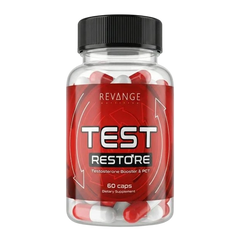
The product
Revange Nutrition Test Restore – Botanical Formula for Men
€54,90 · Sold out