

Product guide · Research use only
Alluvi GLOW BPC-157 / TB-500 / GHK-Cu peptide blend, 2 pens
Alluvi peptide product containing BPC-157, TB-500 and GHK-Cu, peptide blend in pen format. This guide sets out what the manufacturer states about the composition of Alluvi GLOW BPC-157 / TB-500 / GHK-Cu peptide blend, 2 pens, what independent research says about its main ingredients, and the safety and regulatory points that apply. The manufacturer labels this product for research use only, not for human consumption. This guide is educational and gives no directions for use.
Back to the product- Named ingredients
- 3
- Amounts stated
- All
- Status
- Research use only
- Evidence summaries
- 3
Overview
Manufacturer informationThe manufacturer labels it for research use only, not for human consumption.
Ingredients & composition
Manufacturer information| Ingredient | Amount |
|---|---|
| BPC-157 | 5 mg per pen |
| TB-500 | 5 mg per pen |
| GHK-Cu | 25 mg per pen |
Scientific background
Independent researchBPC-157
BPC-157 ("body protection compound") is a synthetic peptide of 15 amino acids, derived from a sequence of a protein in human gastric juice. It is studied for tissue healing1.
TB-500 (thymosin β4 fragment)
TB-500 is marketed as a synthetic version or fragment of thymosin β4 (Tβ4), a naturally occurring protein involved in cell migration and tissue repair2.
GHK-Cu (copper tripeptide)
GHK-Cu is a naturally occurring copper complex of the tripeptide glycyl-histidyl-lysine. It is widely used in topical cosmetic products3.
Research evidence
Independent researchBPC-157
Most research on BPC-157 consists of animal and cell studies reporting effects on tendon, ligament, muscle and gut healing14.
A 2026 systematic review found only three small human studies: a retrospective study of knee injections, a pilot study in interstitial cystitis and a two-person intravenous safety study. All were of poor methodological quality, and the overall certainty of evidence was very low56.
TB-500 (thymosin β4 fragment)
Thymosin β4 accelerated dermal healing in animal models and in phase 2 trials in patients with pressure ulcers, venous stasis ulcers and epidermolysis bullosa wounds2. Those trials used the full natural protein in clinical settings, not TB-500 products.
GHK-Cu (copper tripeptide)
Laboratory and cosmetic studies report effects on skin repair, collagen and wrinkle appearance with topical use3. There are no controlled trials of injected GHK-Cu in humans.
Evidence limitations
Independent researchThe studies summarised in this guide examined single ingredients. No published study has tested this product or this combination of ingredients.
BPC-157
Reviewers conclude that well-designed human trials are needed to assess safety and efficacy, and that BPC-157 should not be used clinically in humans outside ethically approved, regulated trials54.
TB-500 (thymosin β4 fragment)
There are no published controlled human trials of TB-500 products for muscle or tendon injuries or performance. Reviewers describe a "gray market" of unapproved peptides sold directly to consumers outside regulatory oversight, with uncertain purity and safety7.
GHK-Cu (copper tripeptide)
Much of the research comes from a small group of investigators and from laboratory models3. Results with topical cosmetics cannot be transferred to injectable products. Reviewers describe a "gray market" of unapproved peptides sold directly to consumers outside regulatory oversight, with uncertain purity and safety7.
Safety & potential risks
- The BPC-157 TB-500 GHK-Cu peptide blend is intended solely for research use and is not suitable for human consumption.
- Store the pens in a refrigerator at 2–8 °C and avoid exposure to direct sunlight.
BPC-157
Human safety data are minimal. Reviewers highlight risks from unregulated manufacturing and contamination, and unknown clinical safety8. The US FDA placed BPC-157 among bulk substances that may present significant safety risks in compounding, citing possible immunogenicity and peptide impurities9.
TB-500 (thymosin β4 fragment)
Human safety data for TB-500 products are lacking7.
GHK-Cu (copper tripeptide)
Topical cosmetic use is common; the safety of injecting GHK-Cu has not been established7.
Regulatory status
The BPC-157 / TB-500 / GHK-Cu blend is supplied as a research peptide that requires reconstitution and injection. It is not a food or food supplement and is not an authorised medicinal product in the EU. No dosing information for human use is provided.
BPC-157
BPC-157 is not authorised as a medicine or as a food in the EU1011. The World Anti-Doping Agency prohibits non-approved substances such as BPC-157 at all times12.
TB-500 (thymosin β4 fragment)
TB-500 is not authorised as a medicine or as a food in the EU1011. The World Anti-Doping Agency prohibits non-approved substances and peptide hormones, growth factors and related substances at all times12.
GHK-Cu (copper tripeptide)
GHK-Cu is used as a cosmetic ingredient. As an injectable product it is not an authorised medicine in the EU10.
Scientific references
- Józwiak M, Bauer M, Kamysz W, et al. Multifunctionality and possible medical application of the BPC 157 peptide: literature and patent review. Pharmaceuticals (Basel). 2025;18:185. PubMed 40005999
- Kleinman HK, Sosne G. Thymosin β4 promotes dermal healing. Vitam Horm. 2016;102:251-275. PubMed 27450738
- Pickart L, Vasquez-Soltero JM, Margolina A. GHK peptide as a natural modulator of multiple cellular pathways in skin regeneration. Biomed Res Int. 2015;2015:648108. PubMed 26236730
- McGuire FP, Martinez R, Lenz A, et al. Regeneration or risk? A narrative review of BPC-157 for musculoskeletal healing. Curr Rev Musculoskelet Med. 2025;18:611-619. PubMed 40789979
- Poolton JT, Minett J, Kazmi A. Human evidence for BPC-157 in orthopaedic and regenerative medicine: a systematic review of efficacy and safety. Acta Orthop Belg. 2026;92. PubMed 42885452
- Lee E, Padgett B. Intra-articular injection of BPC 157 for multiple types of knee pain. Altern Ther Health Med. 2021;27:8-13. PubMed 34324435
- Mendias CL, Awan TM. Safety and efficacy of approved and unapproved peptide therapies for musculoskeletal injuries and athletic performance. Sports Med. 2026;56:1921-1935. PubMed 41966639
- Vasireddi N, Hahamyan H, Salata MJ, et al. Emerging use of BPC-157 in orthopaedic sports medicine: a systematic review. HSS J. 2025;21:485-495. PubMed 40756949
- US Food and Drug Administration. Certain bulk drug substances for use in compounding that may present significant safety risks (lists BPC-157). Source
- Directive 2001/83/EC on the Community code relating to medicinal products for human use. Official Journal of the European Union. Source
- Regulation (EU) 2015/2283 on novel foods. Official Journal of the European Union. Source
- World Anti-Doping Agency. The Prohibited List (current edition). Source
Sources checked against PubMed, Crossref or the official publisher on 2026-11-04. Manufacturer information is taken from the product's own data and has not been independently tested.
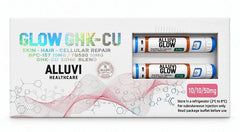
The product
Alluvi GLOW BPC-157 / TB-500 / GHK-Cu peptide blend, 2 pens
€149,90