

Product guide · Restricted substance
GynSyn Labs RAD 150 30 ml (1 ml 30mg)
Research compound from GynSyn Labs, 30 ml of liquid. This guide sets out what the manufacturer states about the composition of GynSyn Labs RAD 150 30 ml (1 ml 30mg), what independent research says about its main ingredient, and the safety and regulatory points that apply. It contains substances that are not authorised as food or medicine in the EU. This guide is educational: it does not recommend use and gives no directions for use.
Back to the product- Named ingredients
- 1
- Amounts stated
- None
- Status
- Restricted substance
- Evidence summaries
- 1
Overview
Manufacturer informationGynSyn Labs RAD 150 30 ml (1 ml 30mg) contains RAD 150. Each pack holds 30 ml (liquid). The strength is given in the product title.
Ingredients & composition
Manufacturer information| Ingredient | Amount |
|---|---|
| RAD 150 | Not stated |
The manufacturer does not state the amount of any ingredient. Without amounts, the research summarised in this guide cannot be related to this product's dose.
Scientific background
Independent researchRAD-150
RAD-150 (sometimes sold as TLB-150) is marketed as an esterified derivative of RAD-140. No peer-reviewed research on RAD-150 itself has been published; the information available concerns RAD-1401.
Research evidence
Independent researchRAD-150
There are no published human or animal studies of RAD-150. For RAD-140, the only human trial was a phase 1 study in women with advanced breast cancer2.
Evidence limitations
Independent researchThis product does not state all ingredient amounts, so the doses used in research cannot be compared with what one serving provides.
No published study has tested this specific product; the research summarised here concerns the ingredient itself.
RAD-150
Its identity, purity and effects have not been characterised in the scientific literature. Analyses of products sold online as SARMs found that many did not contain the substance or amount stated on the label, and some contained other unapproved drugs3.
Safety & potential risks
Independent researchRAD-150
Human safety is unknown. Liver injury has been reported with products containing RAD-1404. A systematic review of SARM use by athletes reports liver toxicity, heart toxicity, tendon damage, suppression of natural testosterone and other androgenic effects5. A national case series linked SARMs and other bodybuilding products to drug-induced liver injury6.
Regulatory status
Contains a selective androgen receptor modulator (SARM). SARMs are investigational substances that are not authorised as medicinal products or as food (including food supplements) in the EU and are on the World Anti-Doping Agency (WADA) Prohibited List. No dosing information for human use is provided.
Scientific references
- Miller CP, Shomali M, Lyttle CR, et al. Design, synthesis, and preclinical characterization of the selective androgen receptor modulator (SARM) RAD140. ACS Med Chem Lett. 2011;2:124-129. PubMed 24900290
- LoRusso P, Hamilton E, Ma C, et al. A first-in-human phase 1 study of a novel selective androgen receptor modulator (SARM), RAD140, in ER+/HER2- metastatic breast cancer. Clin Breast Cancer. 2022;22:67-77. PubMed 34565686
- Van Wagoner RM, Eichner A, Bhasin S, et al. Chemical composition and labeling of substances marketed as selective androgen receptor modulators and sold via the internet. JAMA. 2017;318:2004-2010. PubMed 29183075
- Barbara M, Dhingra S, Mindikoglu AL. Drug-induced liver injury associated with Alpha Bolic (RAD-140) and Alpha Elite (RAD-140 and LGD-4033). ACG Case Rep J. 2020;7:e00409. PubMed 33062783
- Vasireddi N, Hahamyan HA, Gould HP, et al. Athlete selective androgen receptor modulators abuse: a systematic review. Am J Sports Med. 2025;53:999-1009. PubMed 39755947
- Nash E, Nicoll A, Batt N, et al. Drug-induced liver injury from selective androgen receptor modulators, anabolic-androgenic steroids and bodybuilding supplements in Australia. Aliment Pharmacol Ther. 2024;59:953-961. PubMed 38372012
- Directive 2001/83/EC on the Community code relating to medicinal products for human use. Official Journal of the European Union. Source
- Regulation (EU) 2015/2283 on novel foods. Official Journal of the European Union. Source
- Thevis M, Schänzer W. Detection of SARMs in doping control analysis. Mol Cell Endocrinol. 2018;464:34-45. PubMed 28137616
- World Anti-Doping Agency. The Prohibited List (current edition). Source
Sources checked against PubMed, Crossref or the official publisher on 2026-11-04. Manufacturer information is taken from the product's own data and has not been independently tested.
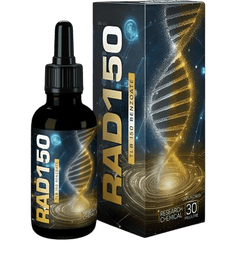
The product
GynSyn Labs RAD 150 30 ml (1 ml 30mg)
€59,90 · Sold out