

Product guide · Food supplement
Hammer Labz Crea5 Strength – комплекс креатина для роста сухой мышечной массы
Creatine stack from Hammer Labz, powder. This guide sets out what the manufacturer states about the composition of Hammer Labz Crea5 Strength, what independent research says about its main ingredients, and the safety and regulatory points that apply.
Back to the product- Named ingredients
- 6
- Amounts stated
- None
- Status
- Food supplement
- Evidence summaries
- 4
Overview
Manufacturer informationCrea5 Strength combines five creatine forms (monohydrate, HCl, tri-creatine malate, magnesium creatine chelate and nitrate) with glycerol monostearate and arginine AAKG. One serving is mixed with 200 ml of water.
Ingredients & composition
Manufacturer information| Ingredient | Amount |
|---|---|
| Creatine monohydrate | Not stated |
| Creatine HCl | Not stated |
| Tri-creatine malate | Not stated |
| Magnesium creatine chelate | Not stated |
| Creatine nitrate | Not stated |
| Glycerol monostearate | Not stated |
| Arginine AAKG | Not stated |
The manufacturer does not state the amount of any ingredient. Without amounts, the research summarised in this guide cannot be related to this product's dose.
Scientific background
Independent researchCreatine monohydrate
Creatine is a compound the body makes from the amino acids arginine, glycine and methionine, and it is also eaten in meat and fish. Most of it is stored in skeletal muscle, where phosphocreatine helps regenerate ATP, the immediate energy source for short, intense muscle contractions1.
Creatine monohydrate is the form used in most of the published research12.
Other creatine forms (creatine HCl, nitrate, pyruvate)
Several alternative forms of creatine are marketed, such as creatine hydrochloride, creatine nitrate and creatine pyruvate. Creatine monohydrate is the form used in almost all research1.
Magnesium
Magnesium is an essential mineral involved in hundreds of enzyme reactions, including energy metabolism, muscle contraction and nerve function3.
EFSA set adequate intakes of 350 mg a day for men and 300 mg a day for women, from all sources4. Supplements supply magnesium bound to different partners, such as oxide, citrate or glycinate. Labels should state the amount of elemental magnesium, which is lower than the weight of the compound.
L-arginine and AAKG
L-arginine is an amino acid used by the body to make nitric oxide. AAKG is arginine bound to alpha-ketoglutarate.
Research evidence
Independent researchCreatine monohydrate
Supplementation raises muscle creatine stores. The International Society of Sports Nutrition position stand concludes that creatine monohydrate is an effective ergogenic supplement for increasing high-intensity exercise capacity and lean body mass during training1.
A meta-analysis of randomised trials found improved upper-limb strength when creatine was combined with resistance training5, and a meta-analysis in older adults found greater gains in muscle mass and strength with creatine plus resistance training than with training alone6.
In the EU, the European Food Safety Authority (EFSA) assessed the evidence and found a cause-and-effect relationship between a daily intake of 3 g of creatine and increased physical performance in successive bursts of short-term, high-intensity exercise7. That claim is authorised under Regulation (EU) No 432/20128, and a second claim on muscle strength in adults over 55 who do resistance training under Regulation (EU) 2017/6729.
Other creatine forms (creatine HCl, nitrate, pyruvate)
There is little evidence that alternative creatine forms are more effective than creatine monohydrate12.
Magnesium
Authorised EU claims include that magnesium contributes to a reduction of tiredness and fatigue, to normal muscle function and to normal functioning of the nervous system, for foods that are a source of magnesium8.
For exercise performance, a review found that supplementation may help people with low magnesium status or older adults, but found no clear benefit in people who already have enough magnesium10.
L-arginine and AAKG
A dose-response meta-analysis of randomised trials found that L-arginine lowered blood pressure in adults11. Evidence for improved exercise performance or "pump" is inconsistent; oral arginine is extensively broken down before reaching the circulation, which is why citrulline is often preferred12.
Evidence limitations
Independent researchThis product does not state all ingredient amounts, so the doses used in research cannot be compared with what one serving provides.
The studies summarised in this guide examined single ingredients. No published study has tested this product or this combination of ingredients.
Creatine monohydrate
The benefits shown are for repeated short, high-intensity efforts and for training adaptations. They do not extend to endurance performance, which EFSA did not find to be substantiated7.
Individual responses vary, and many trials are small and short1.
Other creatine forms (creatine HCl, nitrate, pyruvate)
Few controlled trials have tested these forms, and the creatine content per gram differs between them.
Magnesium
Many studies on magnesium and health are observational or involve people with low magnesium status, so their findings do not show that extra magnesium helps people who are not deficient103.
L-arginine and AAKG
Studies vary in dose and population11.
Safety & potential risks
- Do not exceed the recommended daily dose.
- Food supplements should not be used as a substitute for a varied and balanced diet and a healthy lifestyle.
- Keep out of the reach of young children.
Creatine monohydrate
Reviews of the clinical literature report no consistent adverse effects of creatine monohydrate in healthy people at commonly studied intakes. A meta-analysis found no significant effect on markers of kidney function132.
People with kidney disease, and anyone taking medication, should speak to a doctor before using creatine. A small rise in blood creatinine is expected with supplementation and can be misread as reduced kidney function2.
Other creatine forms (creatine HCl, nitrate, pyruvate)
Safety data come mainly from creatine monohydrate1.
Magnesium
The EU Scientific Committee on Food set a tolerable upper intake level of 250 mg a day for magnesium from supplements and fortified foods (readily dissociable salts and compounds such as magnesium oxide), based on mild, reversible diarrhoea as the most sensitive effect. Magnesium in normal food is not included14.
People with impaired kidney function can accumulate magnesium and should only supplement under medical advice. Magnesium can reduce the absorption of some antibiotics and osteoporosis medicines, so separate them by several hours or ask a pharmacist3.
Regulatory status
Sold as a food supplement. No health claims are made for this product.
Creatine monohydrate
Creatine is sold in the EU as a food supplement ingredient under the food supplements framework16. Only the authorised wording of the two creatine health claims may be used, and only at the qualifying intake of 3 g a day89.
Other creatine forms (creatine HCl, nitrate, pyruvate)
The EU-authorised creatine claims refer to creatine; the qualifying amount is 3 g of creatine a day8.
Scientific references
- Kreider RB, Kalman DS, Antonio J, et al. International Society of Sports Nutrition position stand: safety and efficacy of creatine supplementation in exercise, sport, and medicine. J Int Soc Sports Nutr. 2017;14:18. PubMed 28615996
- Antonio J, Candow DG, Forbes SC, et al. Common questions and misconceptions about creatine supplementation: what does the scientific evidence really show? J Int Soc Sports Nutr. 2021;18:13. PubMed 33557850
- Fiorentini D, Cappadone C, Farruggia G, et al. Magnesium: biochemistry, nutrition, detection, and social impact of diseases linked to its deficiency. Nutrients. 2021;13:1136. PubMed 33808247
- EFSA Panel on Dietetic Products, Nutrition and Allergies. Scientific Opinion on Dietary Reference Values for magnesium. EFSA Journal. 2015;13(7):4186. DOI 10.2903/j.efsa.2015.4186
- Lanhers C, Pereira B, Naughton G, et al. Creatine supplementation and upper limb strength performance: a systematic review and meta-analysis. Sports Med. 2017;47:163-173. PubMed 27328852
- Devries MC, Phillips SM. Creatine supplementation during resistance training in older adults: a meta-analysis. Med Sci Sports Exerc. 2014;46:1194-1203. PubMed 24576864
- EFSA Panel on Dietetic Products, Nutrition and Allergies. Scientific Opinion on the substantiation of health claims related to creatine and increase in physical performance during short-term, high intensity, repeated exercise bouts. EFSA Journal. 2011;9(7):2303. DOI 10.2903/j.efsa.2011.2303
- Commission Regulation (EU) No 432/2012 establishing a list of permitted health claims made on foods. Official Journal of the European Union. Source
- Commission Implementing Regulation (EU) 2017/672 authorising a health claim made on foods (creatine and muscle strength in adults over 55). Official Journal of the European Union. Source
- Zhang Y, Xun P, Wang R, et al. Can magnesium enhance exercise performance? Nutrients. 2017;9:946. PubMed 28846654
- Shiraseb F, Asbaghi O, Bagheri R, et al. Effect of L-arginine supplementation on blood pressure in adults: a systematic review and dose-response meta-analysis of randomized clinical trials. Adv Nutr. 2022;13:1226-1242. PubMed 34967840
- Gonzalez AM, Trexler ET. Effects of citrulline supplementation on exercise performance in humans: a review of the current literature. J Strength Cond Res. 2020;34:1480-1495. PubMed 31977835
- de Souza E Silva A, Pertille A, Reis Barbosa CG, et al. Effects of creatine supplementation on renal function: a systematic review and meta-analysis. J Ren Nutr. 2019;29:480-489. PubMed 31375416
- Scientific Committee on Food / EFSA. Tolerable Upper Intake Levels for Vitamins and Minerals. European Food Safety Authority; 2006. Source
- Shao A, Hathcock JN. Risk assessment for the amino acids taurine, L-glutamine and L-arginine. Regul Toxicol Pharmacol. 2008;50:376-399. PubMed 18325648
- Directive 2002/46/EC on the approximation of the laws of the Member States relating to food supplements. Official Journal of the European Union. Source
Sources checked against PubMed, Crossref or the official publisher on 2026-11-04. Manufacturer information is taken from the product's own data and has not been independently tested.
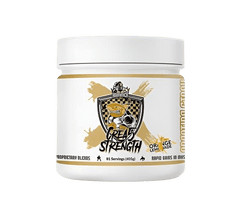
The product
Hammer Labz Crea5 Strength – комплекс креатина для роста сухой мышечной массы
€29,00