

Product guide · Restricted substance
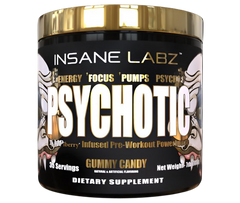
Insane Labz Psychotic Gold
Stimulant formula from Insane Labz. This guide sets out what the manufacturer states about the composition of Insane Labz Psychotic Gold, what independent research says about its main ingredients, and the safety and regulatory points that apply. It contains substances that are not authorised as food or medicine in the EU. This guide is educational: it does not recommend use and gives no directions for use.
Back to the product- Named ingredients
- 8
- Amounts stated
- None
- Status
- Restricted substance
- Evidence summaries
- 5
Overview
Manufacturer informationIngredients & composition
Manufacturer information| Ingredient | Amount |
|---|---|
| Beta-Alanine | Not stated |
| Citrulline malate (2:1) | Not stated |
| Agmatine sulfate | Not stated |
| DMAE | Not stated |
| Caffeine citrate | Not stated |
| Ampiberry™ (Juniper berry extract) | Not stated |
| Rauwolfia vomitoria (Alpha yohimbine) | Not stated |
| Olivox™ | Not stated |
The manufacturer does not state the amount of any ingredient. Without amounts, the research summarised in this guide cannot be related to this product's dose.
Not covered in detail in this guide: DMAE, Ampiberry™ (Juniper berry extract), Olivox™.
Scientific background
Independent researchBeta-alanine
Beta-alanine is an amino acid that combines with histidine in muscle to form carnosine, which helps buffer acid during intense exercise1.
L-citrulline and citrulline malate
L-citrulline is an amino acid that the body converts to arginine, a precursor of nitric oxide, which widens blood vessels. Citrulline malate combines citrulline with malic acid2.
Agmatine sulfate
Agmatine is formed in the body from the amino acid arginine and acts as a signalling molecule in the nervous system. It is sold as agmatine sulfate in sports and nootropic products.
Caffeine
Caffeine is a stimulant that blocks adenosine receptors in the brain, reducing perceived effort and fatigue. It is found in coffee, tea and energy drinks and is a common ingredient in pre-workout products3.
Dicaffeine malate (sold as Infinergy®) is caffeine bonded to malic acid. Its caffeine adds to the total caffeine in a product, but labels do not always state the caffeine equivalent.
Yohimbine (yohimbe bark, rauwolscine)
Yohimbine is an alkaloid from the bark of the African tree Pausinystalia yohimbe. It blocks α2-adrenergic receptors, which increases noradrenaline release. Rauwolscine (alpha-yohimbine) is a closely related alkaloid.
Research evidence
Independent researchBeta-alanine
The International Society of Sports Nutrition concludes that 4–6 g a day for at least 2–4 weeks raises muscle carnosine and improves performance in exercise lasting about 1–4 minutes1.
A meta-analysis found a significant overall ergogenic effect, with the size of the benefit depending on the type and duration of exercise4.
L-citrulline and citrulline malate
A review of human studies found that citrulline supplementation raises plasma arginine, and that several studies report improved exercise performance or recovery, but the results are inconsistent2.
Agmatine sulfate
Controlled human research on agmatine for exercise performance is very limited. Published human data are mostly small studies and a long-term case report5.
Caffeine
The International Society of Sports Nutrition concludes that caffeine consistently improves exercise performance when consumed in doses of about 3–6 mg per kg of body mass, with benefits for muscular endurance, movement velocity, strength, sprinting, jumping and aerobic exercise3.
Yohimbine (yohimbe bark, rauwolscine)
A small trial in professional soccer players found reduced body fat with yohimbine but no change in body mass, muscle mass or performance6. Larger, independent trials are lacking.
Evidence limitations
Independent researchThis product does not state all ingredient amounts, so the doses used in research cannot be compared with what one serving provides.
The studies summarised in this guide examined single ingredients. No published study has tested this product or this combination of ingredients.
Beta-alanine
Effects on strength and on endurance exercise beyond about 25 minutes are not established1. A single serving taken before training does not reproduce the daily supplementation used in research.
L-citrulline and citrulline malate
Studies differ in dose, form (citrulline or citrulline malate, often with an unverified ratio) and exercise test, and many are small. The mechanism behind any performance effect is not established2.
Agmatine sulfate
There are no large randomised trials showing a performance benefit from agmatine in healthy people. Claims of better "pump" or focus are not established.
Caffeine
Responses vary widely between people, partly because of genetics and habitual caffeine use. Many studies use pure caffeine, so results do not automatically apply to multi-ingredient products3.
Yohimbine (yohimbe bark, rauwolscine)
Evidence for fat loss or performance is limited to small studies. Supplement labels are often inaccurate: of 49 US yohimbine supplements tested, only 2 gave accurate information on both the quantity and the known adverse effects7.
Safety & potential risks
- Due to its potency, this product is not recommended for beginners or those sensitive to stimulants.
Beta-alanine
The only commonly reported side effect is paraesthesia, a harmless tingling of the skin that is more likely with larger single doses1.
L-citrulline and citrulline malate
Citrulline is generally well tolerated in the doses studied. Digestive discomfort has been reported, and people taking blood-pressure or erectile-dysfunction medication should ask a doctor, because citrulline raises arginine and nitric oxide production2.
Agmatine sulfate
A case report described 5 years of high daily agmatine intake without detected adverse effects5. One case report cannot establish safety for the wider population.
Caffeine
EFSA concluded that single doses of up to 200 mg, and daily intakes of up to 400 mg from all sources, do not raise safety concerns for healthy adults. For pregnant and breastfeeding women, daily intakes up to 200 mg do not raise concerns for the foetus or infant8.
Higher intakes can cause anxiety, sleep disturbance, raised heart rate and blood pressure, and digestive upset. Combining several caffeine sources (coffee, energy drinks, pre-workouts) raises total intake83.
Yohimbine (yohimbe bark, rauwolscine)
A review of poison-centre cases found that adverse events with yohimbine products had more serious outcomes than average exposures, including rapid heart rate, anxiety, high blood pressure and agitation9. People with heart conditions, high blood pressure, anxiety disorders or taking antidepressants should not use yohimbine.
Regulatory status
Contains yohimbine. Isolated yohimbine is classified as a medicinal substance in several EU member states; its legal status depends on the country of sale.
Beta-alanine
Beta-alanine is used in EU food supplements under national rules. No health claim is authorised10.
L-citrulline and citrulline malate
L-citrulline is used in EU food supplements under national rules. No health claim for citrulline is authorised in the EU10.
Agmatine sulfate
Agmatine sulfate is used in some EU food supplements under national rules. No health claim is authorised10. Whether a product needs novel food authorisation depends on its history of use11.
Caffeine
Caffeine is permitted in EU foods and food supplements, subject to labelling rules. It is not on the World Anti-Doping Agency Prohibited List12.
Scientific references
- Trexler ET, Smith-Ryan AE, Stout JR, et al. International society of sports nutrition position stand: beta-alanine. J Int Soc Sports Nutr. 2015;12:30. PubMed 26175657
- Gonzalez AM, Trexler ET. Effects of citrulline supplementation on exercise performance in humans: a review of the current literature. J Strength Cond Res. 2020;34:1480-1495. PubMed 31977835
- Guest NS, VanDusseldorp TA, Nelson MT, et al. International Society of Sports Nutrition position stand: caffeine and exercise performance. J Int Soc Sports Nutr. 2021;18:1. PubMed 33388079
- Saunders B, Elliott-Sale K, Artioli GG, et al. β-alanine supplementation to improve exercise capacity and performance: a systematic review and meta-analysis. Br J Sports Med. 2017;51:658-669. PubMed 27797728
- Gilad GM, Gilad VH. Long-term (5 years), high daily dosage of dietary agmatine: evidence of safety: a case report. J Med Food. 2014;17:1256-1259. PubMed 25247837
- Ostojic SM. Yohimbine: the effects on body composition and exercise performance in soccer players. Res Sports Med. 2006;14:289-299. PubMed 17214405
- Cohen PA, Wang YH, Maller G, et al. Pharmaceutical quantities of yohimbine found in dietary supplements in the USA. Drug Test Anal. 2016;8:357-369. PubMed 26391406
- EFSA Panel on Dietetic Products, Nutrition and Allergies. Scientific Opinion on the safety of caffeine. EFSA Journal. 2015;13(5):4102. DOI 10.2903/j.efsa.2015.4102
- Kearney T, Tu N, Haller C. Adverse drug events associated with yohimbine-containing products: a retrospective review of the California Poison Control System reported cases. Ann Pharmacother. 2010;44:1022-1029. PubMed 20442348
- Commission Regulation (EU) No 432/2012 establishing a list of permitted health claims made on foods. Official Journal of the European Union. Source
- Regulation (EU) 2015/2283 on novel foods. Official Journal of the European Union. Source
- World Anti-Doping Agency. The Prohibited List (current edition). Source
- Regulation (EC) No 1925/2006 on the addition of vitamins and minerals and of certain other substances to foods. Official Journal of the European Union. Source
- Directive 2001/83/EC on the Community code relating to medicinal products for human use. Official Journal of the European Union. Source
Sources checked against PubMed, Crossref or the official publisher on 2026-11-04. Manufacturer information is taken from the product's own data and has not been independently tested.
The product
Insane Labz Psychotic Gold
€44,90