


Thaiger Pharma
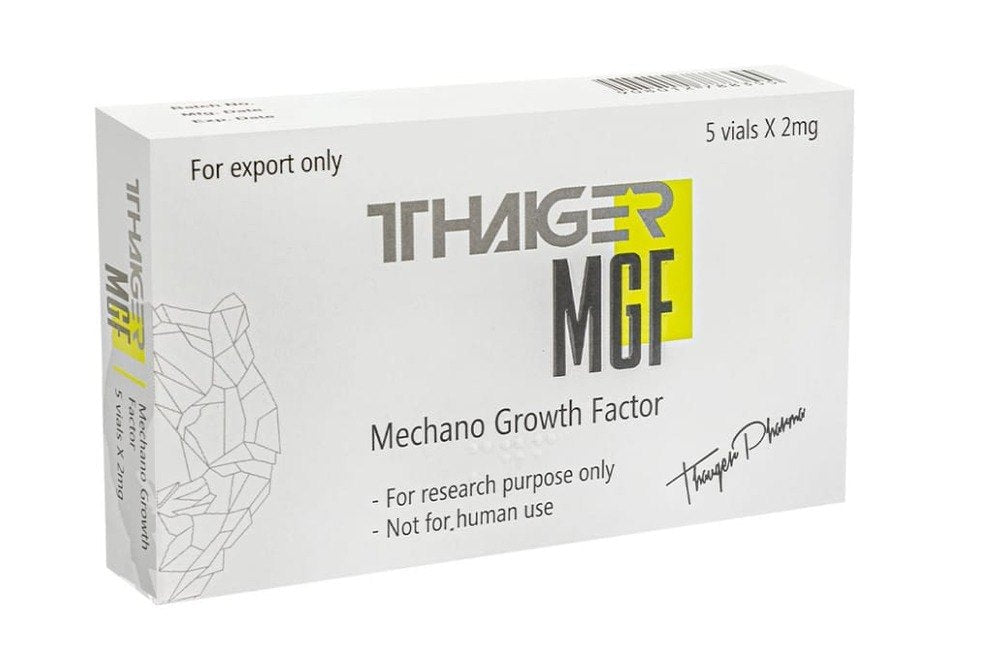
Thaiger Pharma MGF 2mg peptide Muscle Growth Peptide
Thaiger Pharma MGF 2mg peptide Muscle Growth Peptide
Impossibile caricare la disponibilità di ritiro
MGF – 2 mg Muscle Growth Peptide
Thaiger Pharma | Advanced Support for Muscle Growth & Regeneration
MGF (Mechano Growth Factor) 2 mg is an advanced research peptide developed to support muscle growth, tissue regeneration, and adaptation to intense physical training. MGF is a biologically active derivative of IGF-1 (Insulin-like Growth Factor-1), specifically the IGF-1Ec isoform, which becomes active in muscle tissue in response to mechanical stress such as resistance training.
Because of this localized activation, MGF is considered a key factor in post-training muscle repair and long-term hypertrophy potential.
What Is MGF (Mechano Growth Factor)?
MGF is a naturally occurring splice variant of IGF-1 that is produced in muscle tissue after intense mechanical loading. Unlike systemic IGF-1, MGF acts locally within muscle fibers, supporting repair and growth processes triggered by training-induced micro-damage.
This makes MGF especially relevant for athletes focused on muscle quality, recovery, and progressive overload adaptation.
Key Properties of MGF Peptide
Stimulation of Muscle Cell Division
MGF supports satellite cell activation, contributing to muscle hyperplasia (formation of new muscle fibers), which may enhance long-term muscle development potential.
Support for Tissue Repair & Regeneration
By accelerating cellular repair mechanisms, MGF may help:
-
shorten recovery time
-
reduce post-training fatigue
-
allow more frequent and intensive training sessions
Enhanced Protein Synthesis
As a derivative of IGF-1, MGF supports muscle protein synthesis, helping maintain and build lean muscle mass under heavy training loads.
Metabolic Support
MGF may assist in:
-
optimizing energy utilization
-
supporting fat metabolism
-
improving overall training efficiency
Mechanism of Action
MGF exerts anabolic and regenerative effects through several key pathways:
-
Activation of satellite cells
Muscle stem cells responsible for repair, remodeling, and growth. -
Support for nutrient and oxygen delivery
Improved local tissue environment supports recovery processes. -
Reduction of excessive protein breakdown
Especially relevant during intense or high-volume training phases.
Through these mechanisms, MGF supports the body’s natural response to training-induced muscle damage.
Does MGF Affect Other Hormones?
MGF acts primarily locally within muscle tissue as a form of IGF-1.
While it may indirectly interact with broader anabolic signaling pathways, its main role is targeted muscle regeneration and growth, rather than systemic hormonal alteration.
Applications in Sports & Physical Performance
Bodybuilding & Muscle Mass Development
MGF is often considered during bulking or strength phases to support:
-
anabolic signaling
-
faster recovery between sessions
-
overcoming training plateaus
Endurance Sports
For endurance athletes, MGF may help:
-
maintain muscle quality under high energy expenditure
-
support glycogen replenishment
-
improve adaptation to repeated training stress
Combat & High-Impact Sports
In sports such as MMA, boxing, or wrestling, MGF may support:
-
recovery from intense training and competition
-
joint and muscle tissue maintenance
-
anti-catabolic protection during long training camps
Recommended Research Dosage
250-500 mcg on training days,
administered before or after workouts, 3–4 times per week
via subcutaneous injection
⚠️ Dosage information is provided for research and informational purposes only.

Contenuto comprimibile
Dosage
Details
Shipping
Free delivery on orders over €199.00 EUR*
*Delivery with registered post (5-10 business days) - €8.00 EUR for orders under €199.00 EUR
*Express delivery (3-4 business days) - fixed price €15.00 EUR
We will ship your order after receiving confirmation of payment. Shipping is available across all EU countries, ensuring that your orders reach you promptly. With our reliable shipping options, you can choose between standard and express delivery methods according to your needs.
Shipping Delivery Options
When you select our services, you benefit from a range of shipping delivery options. Our standard shipping is convenient for those who are not in a hurry, while our express shipping is perfect for urgent needs. Shipping options include:
- Standard Delivery: Expect your items to arrive within 5-10 business days using registered post.
- Express Delivery: For faster service, select our express delivery which takes only 3-4 business days.
Shipping Rates
We aim to provide competitive shipping rates for our customers. Below is a summary of delivery prices:
| Country | Delivery Price |
|---|---|
| Austria, Belgium, Bosnia & Herzegovina, Bulgaria, Croatia, Cyprus, Czechia, Denmark, Estonia, Faroe Islands, Finland, France, Germany, Greece, Hungary, Ireland, Italy, Latvia, Liechtenstein, Luxembourg, Malta, Monaco, Netherlands, Poland, Portugal, Romania, San Marino, Slovakia, Slovenia, Spain, Sweden, United Kingdom | €8.00 EUR |
As mentioned above, orders exceeding €199.00 EUR qualify for free delivery within these regions. This initiative is part of our commitment to ensuring that our shipping is both budget-friendly and efficient. By choosing our services, you are assured that your shipping needs are well-managed and that there are no hidden costs.
You can also track your order during shipping to stay updated on its progress until it arrives at your door.
Important Shipping Details
To ensure a smooth shipping process, please make sure that:
- Your shipping address is accurate and complete.
- You keep an eye on your email for shipping confirmation and tracking details.
- You are aware of potential delays during peak times or holidays.
We appreciate your business and are dedicated to providing you with the highest level of service. If you have any questions regarding shipping, please feel free to reach out to us.