

Product guide · Food supplement
GN Laboratories Vitamin D3+K2 Liquid 90 Caps
Vitamin D3 and K2 capsules from GN Laboratories, 90 capsules. This guide sets out what the manufacturer states about the composition of GN Laboratories Vitamin D3+K2 Liquid 90 Caps, what independent research says about its main ingredients, and the safety and regulatory points that apply.
Back to the product- Named ingredients
- 3
- Amounts stated
- None
- Status
- Food supplement
- Evidence summaries
- 3
Overview
Manufacturer informationVitamin D3+K2 Liquid combines vitamin D3 with K2Vital®, a form of vitamin K2, in a coconut MCT oil base inside liquid capsules.
Ingredients & composition
Manufacturer information| Ingredient | Amount |
|---|---|
| Vitamin D3 | Not stated |
| Vitamin K2 (K2Vital®) | Not stated |
| Coconut MCT oil | Not stated |
The manufacturer does not state the amount of any ingredient. Without amounts, the research summarised in this guide cannot be related to this product's dose.
Scientific background
Independent researchVitamin D3 (cholecalciferol)
Vitamin D is made in the skin in sunlight and is found in a few foods. It is needed for calcium absorption and bone health. EFSA set an adequate intake of 15 µg (600 IU) a day for adults1. 1 µg equals 40 IU.
Vitamin K (K1 / K2, menaquinone)
Vitamin K is needed for blood clotting and for proteins involved in bone metabolism. It exists as phylloquinone (K1, from leafy vegetables) and menaquinones (K2, such as MK-7)2.
MCT oil (medium-chain triglycerides)
Medium-chain triglycerides are fats, mainly from coconut and palm kernel oil, that are absorbed and metabolised faster than long-chain fats.
Research evidence
Independent researchVitamin D3 (cholecalciferol)
Authorised EU claims include that vitamin D contributes to the maintenance of normal bones, muscle function and immune function3.
In the large VITAL trial, 2000 IU (50 µg) a day of vitamin D3 did not lower the incidence of invasive cancer or major cardiovascular events compared with placebo4. A meta-analysis found that vitamin D supplements did not prevent fractures or falls, or have clinically meaningful effects on bone density5.
Vitamin K (K1 / K2, menaquinone)
Authorised EU claims include that vitamin K contributes to normal blood clotting and to the maintenance of normal bones3.
MCT oil (medium-chain triglycerides)
A meta-analysis found that MCTs supported weight loss and metabolic health in people with overweight or obesity as part of dietary interventions6.
Evidence limitations
Independent researchThis product does not state all ingredient amounts, so the doses used in research cannot be compared with what one serving provides.
The studies summarised in this guide examined single ingredients. No published study has tested this product or this combination of ingredients.
Vitamin D3 (cholecalciferol)
Benefits are clearest for correcting deficiency. Trials in people with adequate vitamin D status show little benefit for bone, cancer or heart outcomes45.
Vitamin K (K1 / K2, menaquinone)
Evidence that extra vitamin K improves bone or heart outcomes in people who are not deficient is limited.
MCT oil (medium-chain triglycerides)
Effects are modest and depend on replacing other fats in the diet6.
Safety & potential risks
- Do not exceed the recommended daily dose.
- Food supplements should not be used as a substitute for a varied and balanced diet and a healthy lifestyle.
- Keep out of the reach of young children.
Vitamin D3 (cholecalciferol)
EFSA set a tolerable upper intake level of 100 µg (4000 IU) a day for adults, based on persistent hypercalciuria (excess calcium in the urine) as an early sign of excess vitamin D7. Long-term intakes above this level can raise blood calcium and harm the kidneys. High-dose products should only be used on medical advice.
Vitamin K (K1 / K2, menaquinone)
People taking warfarin or other vitamin K antagonist anticoagulants must not start or change vitamin K supplements without medical advice, because vitamin K counteracts these medicines.
MCT oil (medium-chain triglycerides)
Large amounts can cause digestive upset.
Regulatory status
Sold as a food supplement. No health claims are made for this product.
Vitamin D3 (cholecalciferol)
It is a permitted nutrient in EU food supplements8; authorised claims may only be used in their approved wording and when the product is at least a source of the nutrient3.
Scientific references
- EFSA NDA Panel. Dietary reference values for vitamin D. EFSA Journal. 2016;14:4547. DOI 10.2903/j.efsa.2016.4547
- EFSA NDA Panel. Dietary reference values for vitamin K. EFSA Journal. 2017;15:4780. DOI 10.2903/j.efsa.2017.4780
- Commission Regulation (EU) No 432/2012 establishing a list of permitted health claims made on foods. Official Journal of the European Union. Source
- Manson JE, Cook NR, Lee IM, et al. Vitamin D supplements and prevention of cancer and cardiovascular disease. N Engl J Med. 2019;380:33-44. PubMed 30415629
- Bolland MJ, Grey A, Avenell A. Effects of vitamin D supplementation on musculoskeletal health: a systematic review, meta-analysis, and trial sequential analysis. Lancet Diabetes Endocrinol. 2018;6:847-858. PubMed 30293909
- He H, Liu K, Liu M, et al. The impact of medium-chain triglycerides on weight loss and metabolic health in individuals with overweight or obesity: a systematic review and meta-analysis. Clin Nutr. 2024;43:1755-1768. PubMed 38936302
- EFSA NDA Panel. Scientific opinion on the tolerable upper intake level for vitamin D, including the derivation of a conversion factor for calcidiol monohydrate. EFSA Journal. 2023;21:8145. DOI 10.2903/j.efsa.2023.8145
- Directive 2002/46/EC on the approximation of the laws of the Member States relating to food supplements. Official Journal of the European Union. Source
Sources checked against PubMed, Crossref or the official publisher on 2026-11-04. Manufacturer information is taken from the product's own data and has not been independently tested.
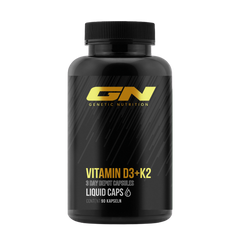
The product
GN Laboratories Vitamin D3+K2 Liquid 90 Caps
€27,90